Saturday, May 1, 2010

Israel, Last Post! : Dead Sea and Masada

Our last day in Israel, we drove from Jerusalem back down south to the Egyptian border at Eilat. On the way, we stopped at the Dead Sea which looked both beautiful and other-worldly. On the southern end of the sea, we drove past a plant which processes the salt....that's a huge wall of salt outside David's window.


Next stop was Masada, a mountain fortress where Herod built one of his palaces. About a century later, in 66 AD, the Jewish resistance captured the stronghold and held it as the last bastion of resistance against the Romans. The Romans used captured Jews to build a ramp over a gorge and up the mountainside and, after several months, finally succeeded in breaching the wall. Once inside the walls, as the story goes, the Romans found the residents dead; they had systematically killed themselves with each father killing his immediate family and then each man killed by a group of ten, who then executed themselves. With the destruction of Masada , the Israeli state ceased to exist for the next 1900 years. Masada is a powerful symbol of Jewish identity and we read that new Army recruits swear their allegiance with the oath "Masada shall never fall again!"

Masada:


You can climb up but we didn't have time so took the cable car.


From up on top, we could look down and see the remnants of the Roman encampment as they lay siege on the fortress.


And, from on top looking down, here's a photo of the assault ramp the Romans built....almost 400 ft. high. I found it amazing that it's still there!


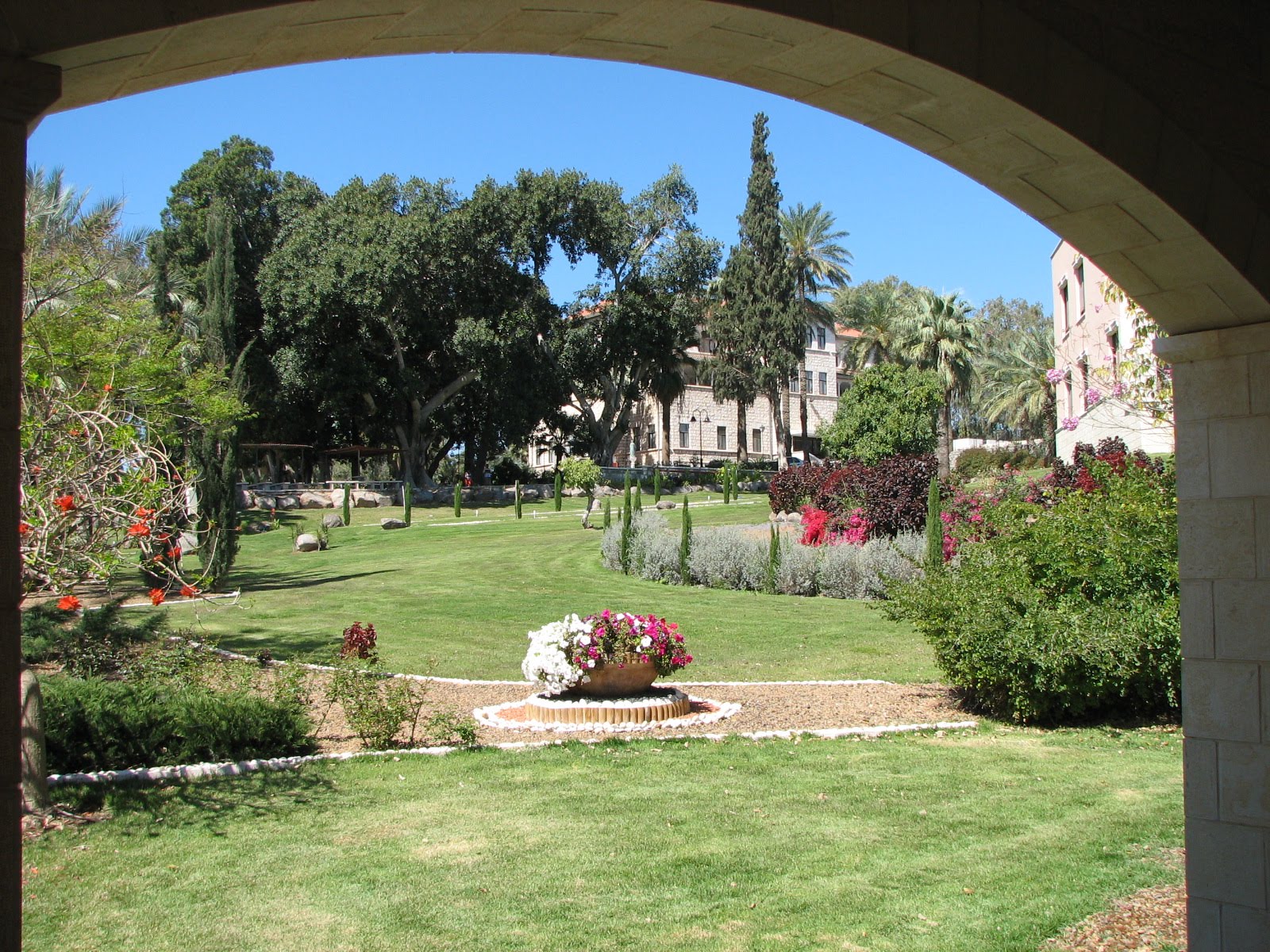
That night we crossed back over to the Egyptian side of the border, after some delay and Visa confusion at the border I might add, but it all worked out alright. Very nice border patrol but weird Visa regulations. We stayed the night in the resort town of Taba Heights....everything looked very nice but we were too spent to really take advantage of it all. :) It was a wonderful trip to Israel and we couldn't ask for better travel partners in Art and Suzy, but I think I can safely say that we were exhausted....traveled out....looking forward to getting back home by this point. This was the view from our balcony:

Friday, April 30, 2010

Israel, Part 6: Jerusalem

Next day, off to Jerusalem. First we stopped at one of the restaurants in Amirim for breakfast and, while we were just expecting to get a danish and coffee, we were treated to a succession of platters of breads, spreads, jams, salads, cannolis. A breakfast feast.


Here, we're sitting out on the veranda, drinking herb tea and eating our apple cake, mustering our energy for our 3 hour drive to Jerusalem. :)


For our two nights in Jerusalem, we stayed in a convent....the convent of the Sisters of the Rosary which we were told was a Middle Eastern order. This was their chapel:


Some sights from our day in the Old City: First stop, the Western Wall, the only remnant of the Temple. Here are the signs at the entrance of the plaza. I didn't realize that Jews believed that the presence of God was still here, dwelling in the vestiges of the Temple. That is not my belief but I was pretty awed by the idea that God once dwelled here, plus it was very interesting to watch others as they rocked back and forth, weeping or chanting the Torah or Mishnah quietly to themselves, and then backing away from the wall by walking backwards....not wanting to turn their backs to the presence of God.


As you can see from the first photo, the men and women are partitioned at the wall. On the men's side, there was a group holding hands in a circle and singing, I'm guessing it was a bar mitzvah. The women's side was less boisterous with each preoccupied with her own thoughts and prayers.


Our next stop was in the Christian quarter of the Old City. We stopped by the Lutheran Church of the Redeemer, built by Kaiser Wilhelm II, who came to dedicate it in person in 1898. We climbed up the bell tower for some wonderful views of the Old City around us. The first photo shows the spartan interior of the church; the second shows a view of the Dome of the Rock, on top of the Temple Mount, with the Mount of Olives and Garden of Gethsamene behind it.


Next stop, just a block away, was the Church of the Holy Sepulchre, which some people believe was the place Jesus died on the cross and was buried. There are six different denominations who control various sections of the church and there have been so many squabbles that back in the 1800s, there was an agreement on who controlled what and which areas were common areas. It was agreed that nothing could happen in any of the common areas without the agreement of all six parties. This has created a fragile stability, a thinly-veiled status quo which erupts with just the smallest incident. A small example of this happened in 2002 when a Coptic monk moved his chair from the sun into the shade which was in the Ethiopian Orthodox section. This was viewed by the Ethiopians as a hostile encroachment, a fistfight broke out, and eleven were hospitalized.
This photo shows another example. See the ladder under the second-story window?? Someone placed that ladder there before the common areas were established in 1852. Once the doors and windows were deemed common areas, the sects will not agree that the ladder should be moved....a powerful and sad symbol of how religion can be an obstruction to God.


The church is a dark, confusing mishmash of structures and styles, again, a sad human testament to the what is arguably the most important event in human history.


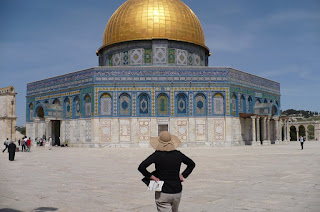
Then Art and I left Suzy and David at an Armenian restaurant in the Armenian quarter and walked up to the Temple Mount. The Temple Mount is controlled by Moslems and they only allow non-Moslems on top for a few hours each day. The Dome of the Rock is stunning and, yes, that's real gold. I asked if we could enter but was politely told it wasn't open to non-Moslems. It would have been neat to see the rock, but it was enough to see the dome up close and also to be up on the mount where the temple used to be.

We walked through the Moslem quarter, along the Via Dolorosa, back to join David and Suzy. The first photo is the Via Dolorosa and the second is a remnant of the Tower of David, part of Herod's palace complex. An amazing day.


Sunday, April 18, 2010

Israel, part 5: Sea of Galilee


I now rank the Sea of Galilee as one of the most beautiful lakes I've seen, up there with Buttermere in the English Lake District and Wallowa Lake in northeastern Oregon. We took a day to explore the east and north edges of the lake, starting with the museum in Tiberias which houses a 1st c. fishing boat they discovered in 1986. Buried in mud, the boat began to disintegrate as soon as it was exposed to air, so the story of how they excavated and preserved the boat was very interesting.


The museum for the boat was large and modern, set up for hundreds of tourists at a time. Actually, we saw several sites along the Sea of Galilee which had been built up to accommodate large tour groups being shepherded around the lake in very large tour buses. For example, these photos are from the Mount of Beatitudes, where Jesus preached the Sermon on the Mount, which has been built up into a lush garden and chapel complex, complete with a snack bar.


I was trying to imagine what the area might have originally looked like.....a fruitless task 2000 years later. Although it was neat to look at the water, the cliffs, the general lay of the land and to think that this was much the same way it looked back then. I won't pretend to guess what Art and David were thinking. :)


Next we stopped at the Church of the Fish and Loaves, purportedly at the site of Jesus' feeding of the 5000. For most of these Sea of Galilee tourist sites, there was no evidence other than the remnants of very early churches built in memory of the event. For example, there was a Church of the feeding of the 5000 built at this location as early as 350 AD.


A 4th century pilgrim from Spain described the church:

By the sea is a grassy field with plenty of hay and many palm trees. By them are seven springs (heptapegon), each flowing strongly. And this is the field where the Lord fed the people with the five loaves and two fishes. In fact the stone on which the Lord placed the bread has now been made into an altar. People who go there take away small pieces of the stone to bring them prosperity, and they are very effective.

They still have a stone under the altar, probably not the same stone, but they're not allowing anyone to chip away pieces of it! That would have been a major boon for Suzy's rock collection. :) The beautiful mosaic floors in the church are mostly from the 5th century.


Down the road a little bit was the village of Capernaum, one of my favorite places we visited that day. Here you can see the ruins of the village Jesus lived in for a time, where he performed at least two miracles, and where he spoke in the Synagogue. While a remnant of the 1st c. synagogue still exists, these remnants are from a 4th c. synagogue built on top.


Just a few hundred feet from the synagogue lie the remains of an octagonal church built in the 5th c. to indicate the exact location of Peter's house. In the 1960s, archaeologists found that the foundations of this octagonal church were actually built on the walls of a private house...a private house with inscriptions leading researchers to believe that it was used as a meeting place for Christians in the second half of the 1st c. It was amazing to think that this very likely could have been the place Jesus healed Peter's mother-in-law and quite possibly he could have lived here with his disciples Peter and Andrew.


Next, we drove up on to the Golan Heights which rises to the east of the Sea of Galilee. I was surprised by how beautiful it was.....lush pasture land and wildflowers, but peppered with signs warning of landmine danger and other signs of recent warfare such as this abandoned tank.


We stopped at Gamla, famous for its strong defense against the Romans in the 66 AD Jewish revolt. They set up their stronghold on this rock outcropping and and held off the Romans for about 8 months before finally being overrun. About 5000 were killed and another 4000 either fell or jumped to their deaths off the cliff at the far end.


On the way home, we tried to find a place where we could dip our feet into the Jordan river and finally succeeded. :)


After that, we retreated back to our peaceful moshav in the hills. Here are some photos of the sunset over the Sea of Galilee that evening.