Monday, April 5, 2010

Israel Part 1: The Negev


Suzy and I standing guard over the luggage before crossing the border to Israel.

For being such a small country (smaller than New Jersey), we were impressed with the widely diverse landscapes in Israel. We spent our first two nights in the Negev desert. Negev is Hebrew for "south" and indeed makes up the bottom half of the country. This is where Abraham, Isaac, and Jacob tended their flocks and where the Israelites waited out their 40 years before entering the promised land. And, folks, this is rugged country. I hadn't realized that when the Bible talks about an area being wilderness, this is what it's referring to.....nary a tree in sight.


We stayed at a hostel called ibike right on the rim of a huge crater called Makhtesh Ramon. The crater wasn't caused by volcanic activity or a meteor but by water erosion. Here's us on the rim at the visitor's center:


We hiked around a few wadis, canyons or riverbeds which provided seasonal water and vegetation, along the ancient Spice Way, a caravan route Nabatean traders used in the 4th bc from Petra to Gaza where their goods were then shipped to Europe. This one was in the crater:


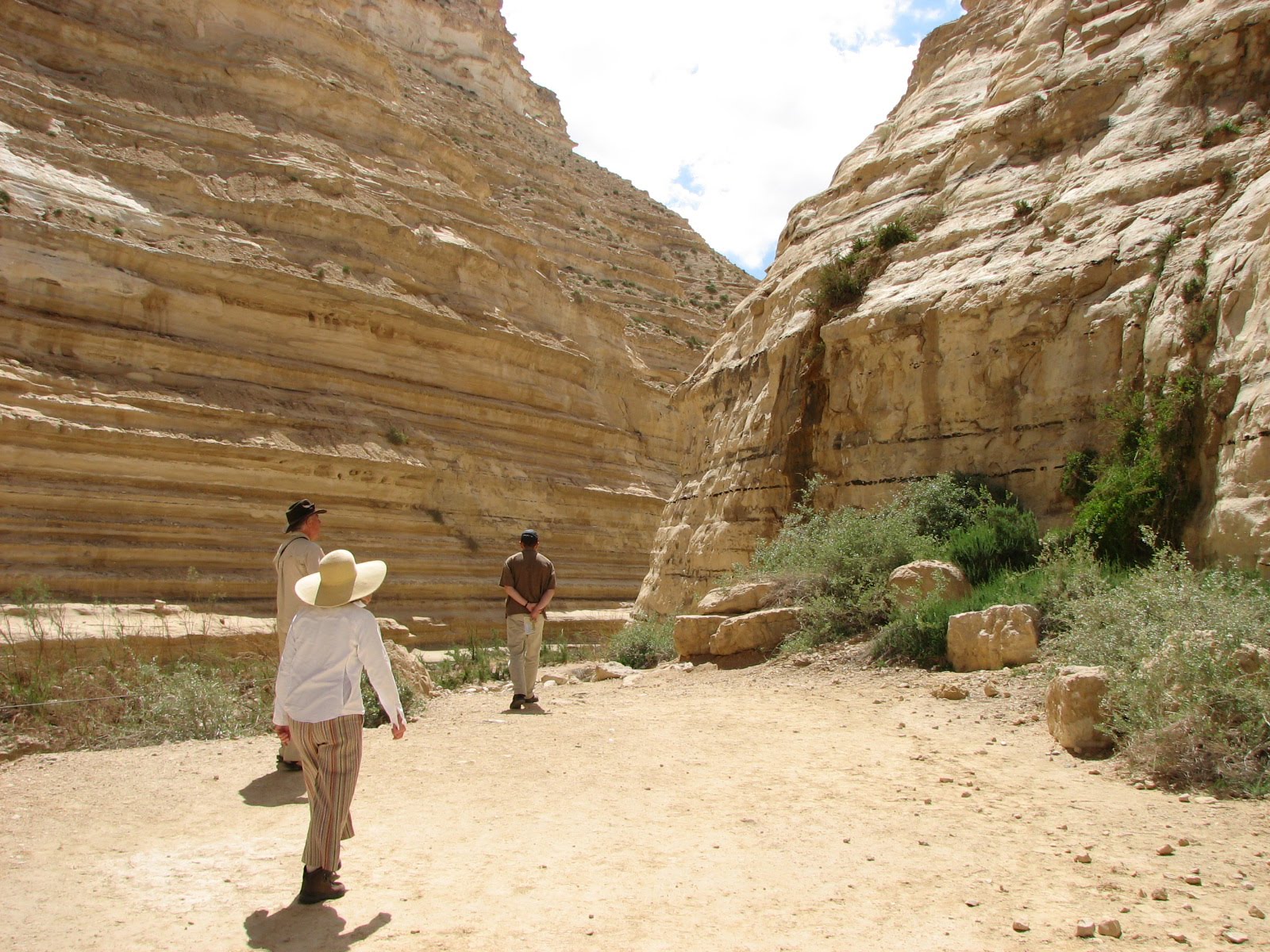
The next day we visited Ein Avdat which is a narrow river canyon in what they think may have been the vast Wilderness of Zin, the area where Moses and the Israelites wandered for forty years (pictured below).


The canyon was beautiful and we even saw some ibex!


We also stopped at the settlement of Avdat which served as a rest stop for the spice caravans, a fortress once the Romans took over, and then as a monastery during the Byzantine era. This is Avdat perched on the hill:


Here's a few pics of the monastery and church. The tomb with the Greek inscription is from the 6th c.


And finally a few photos from the hostel we stayed at. Aviva and Menachem were fun to talk with and I loved Aviva's vegetarian dinner! The following shows Suzy and I chatting over cappucinos, David and Suzy taking a cat nap (I only captured half of Aviva's head in the foreground), and Art and I planning for the next leg of our trip. Stay tuned! :)


Wednesday, March 31, 2010

Valley of the Whales


Hey! Apologies for the small hiatus in posting but David's parents, Art and Suzy (pictured above), were here for the month of March and almost two weeks of that time, we spent in Israel and the Sinai peninsula. More about that in future entries but I wanted to take this post to document our visit to the Valley of the Whales.

The Valley of the Whales is a UNESCO World Heritage site situated in the northwestern corner of the Fayoum delta. They think that this desert valley was the floor of the ancient Eocene sea which reached far south of the existing Mediterranean today. More than 400 whale skeletons have been found here, making it one of the most important fossil deposits in Egypt.

Here is us walking to the kitchen early in the morning to pick up our box lunches. :)


UNESCO has created a nice site here, laying out walking trails that take the visitor to several embedded fossilized mammals which they think may have been the ancestors to our modern whales. Really quite spectacular.


This valley really surprised me as it was unlike anything I'd seen in Egypt. We're hoping to come back soon and camp overnight.

Wednesday, March 10, 2010

Amarna

Last week, a group of us drove about 4 hours south to the ancient city of Amarna. This was no easy task as we had to get permission from the Embassy to drive in that area of Egypt; we had to secure a police escort, submit paperwork to the Embassy and finally found out the afternoon before that, indeed, we could go to Amarna.....whew!

I didn't know anything about Amarna or Akhenaton before I came to Egypt so, for those who don't know, Akhenaten was a pharoah in the 18th dynasty. He was born as Amenhotep IV, named after the main god of that time Amun. He grew up worshipping Amun in the capital city of Thebes but after he became pharoah, for reasons that Egyptologists can only guess at, Amenhotep changed everything. He decided to take a minor god from the Egyptian pantheon, Aton, and elevate him to monotheistic status. He changed his name to Akhenaton which means "It is well with Aton". He moved the capital city from Thebes to a spot hundreds of miles north, creating a new capital called Amarna. There really isn't much left of this city, but remnants of his palace still are visible. Archaeologists back in the 1800s uncovered a beautiful mosaic palace floor which now is displayed in the Egyptian museum in Cairo.


The main attraction of the day were the tombs up in the nearby cliffs. We walked inside four tombs of court officials and what was so fascinating is how different the art is here compared to earlier ancient Egyptian art. Plants and animals look more realistic and humans are depicted very differently. Rather than the stiff cookie-cutter approach, these people have bellies, full hips, elongated heads, and long faces. We were not allowed to bring our cameras inside the tombs, but here are some photos I found online.

Unfortunately, most of the depictions of Akhenaton and his wife Nefertiti were destroyed by Akhenaton's son, Tutankhaton. Once Akhenaton died and Tutankhaton took over the throne, he moved the capital city back to Thebes, changed his name to Tutankhamun to return worship to Amun, and systematically destroyed all evidence that Amarna or his father ever existed. Tutankhamun lived until the ripe old age of 18, they think....a rather insignificant pharoah except for the fact that somehow looters missed his tomb. We know him as King Tut. :)


Aton is a sun god and is depicted as an orb with rays which end in little hands.

Image from Kurohito (http://upload.wikimedia.org/wikipedia/commons/c/ce/Amarna-char_royal.jpg)

Image from Kurohito (http://upload.wikimedia.org/wikipedia/commons/9/98/Amarna2.jpg)


Here's a view of the city from the tombs up on the cliffs. For decades, the Amarna site has been excavated by a group called the Amarna Project which has its home at University of Cambridge. As you can see, most of the city has been reburied by the ubiquitous sand.


Thursday, February 25, 2010

Progressive Dinner

A few days ago, our group here on the compound decided to stage an Italian progressive dinner....six courses in six different villas. The night started off with a nice little sunset as we walked to the first house for drinks.


Two things you may notice in the following photos: 1) All of our villas look the same with the exception that a few have had their walls painted white and 2) I didn't take photos of the food as much as I did the people but you can trust me, the food was wonderful!

First house was Brad's where he served Italian Stallions. A shot of 1/2 Peppermint schnapps, 1/2 Sambuca, a licorice liquor. It was.......interesting.


Next, was bruschetta at Lama's villa:


Then, our house for Italian sausage tortellini soup (by special request, we also played Pavarotti :)


Then, some delicious calamari at Sue's. This is me getting my third plateful. :)


Brian completing the finishing touches on his Shrimp scampi and fettucine alfredo:


Joe's apparently finishing the story he was telling over Calamari :)


Finally, tiramisu and coffee at Anne and Chris's. They have been here for over four years and have seen TAFT teams come and go. Some have a good group dynamic and have fun doing things together and other teams have tended to keep to themselves. Our team comprises one of the former and I'm glad!


Friday, February 19, 2010

Rome!!

Is it possible to casually say that we went to Rome last weekend?? :) Here are some pics from our 3 days there....I only regret that these don't capture my favorite part of the trip: the cappucinos, gelato, wine, pizza, bread, antipasti.....did I mention the gelato???? :)

We've been to Rome once before, but here are a few things I came away with this time.

1. Now that we're seeing through more informed Egyptian eyes, we've noticed that there are ALOT of obelisks in Rome....thirteen in all. Apparently, the Romans felt no compunction about carting off the monuments from their newly conquered territory, proudly displaying them in their public squares, although some were created in Rome as well. Most of them have been "Christianized" by being topped with a cross or a statue of the pope.


Here's one in St. Peter's square, in front of St. Peter's basilica


This little beauty is a miniature Egyptian obelisk atop a baby elephant sculpted by Bernini....apparently, a tongue-in-cheek reference to Hannibal's war elephants which transported siege towers across the Alps to attack Rome in 2nd c. BC. That's the Pantheon in the background.


2. Speaking of Bernini, I finally saw Baroque in a new light. In Rome, we saw Greek statuary everywhere, a testament to the renewed interest and appreciation of classical ideas and art which we know as the Renaissance. This elegant statue was in the Vatican Museum and embodies the Renaissance focus on the beauty of the individual:


In the 17th c., artists took Renaissance art to a new level, focusing on movement and drama. Bernini's sculptures embodied this new style which became known as Baroque. I've never appreciated the flowery, overly decorated style of Baroque but in the Villa Borghese which we visited during our second day in Rome...I got it. Cardinal Borghese, the papal nephew, wanted to illustrate that present-day artists could compete with the classical greats. In each of the grand galleries, renaissance sculptures, stately and pensive, line the edges of the room...but the the sculpture in the center of each room is the main attraction. Each gallery features a sculpture by Bernini and, wow, talk about drama....take a look at this:


This is the same Apollo as the statue above. This time he's grabbed hold of the nymph Daphne just as she's being turned into a laurel tree. Instead of posing gracefully as portrayed in the Vatican, here he's running in mad pursuit and instead of the blank face above, here he's startled, realizing that something's happening to her. Bernini has been able to capture a dramatic moment in marble.

Anyhow, I want to show more Bernini statues from the Galleria Borghese but I'll stop. :) It was a very impressive art collection and the juxtaposition of the Bernini sculptures with the Renaissance figures around it really illustrated how different the Baroque movement was. I came away with a new appreciation, at least. My apologies to those with a greater understanding of art history for any butchering I may have done! :)


3. David and I drank coffee the way the Italians do, ducking into coffee shops, stepping up to the bar and ordering an espresso, or in my case, a macchiato, which is an espresso "stained" with milk. Ten minutes later, we were on our way.


4. We took a tour of the Palatine hill which, according to legend, is the hill where Rome was founded. In Classical Rome, only the very wealthy lived here, including emperors of which Augustus was the first. You can see part of the hill rising up from the Arch of Constantine, erected in 312 AD to celebrate Constantine's triumph over the city (we're standing at the Colosseum).


Here are some of the remains from Augustus's palace on top of the hill. We saw some of the remains of Nero's palace too, including an excavation site where last year they believe they've unearthed his revolving dining room which had only been alluded to in the sources.


The Palatine hill looks down on the Colosseum and the Forum.


It was a lovely walk....one of many we did over our three days there. For souvenirs, we brought home olive oil, balsamic vinegar, and blistered feet!! :)